But the future is far from fixed. We have real opportunities for action. And in writing this email, my hope is to remind you of the good being done by people like you around the world, and the power we have when we act together. As a Greenpeace supporter, you’re helping make victories like these possible. From the bottom of my heart, thank you.
Fossil fuel megaproject GNL Québec defeated!
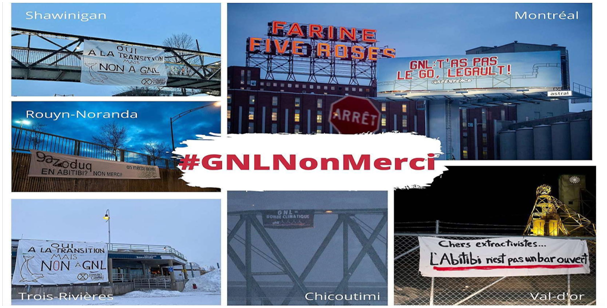
This past March, just days before the Office of Public Hearings on the Environment (BAPE) submitted its conclusions to Premier Legault, the sun rose on six banners displaying communities’ opposition to GNL Québec.
Designed as a three-in-one gas plant, marine export terminal, and pipeline project, GNL Québec would have threatened the survival of the endangered St. Lawrence beluga whale, emitted as much pollution as 15 million cars every year for 25 years, and further delayed the green energy transition.[1][2][3] Now, no part of GNL Québec will see the light of day.
This win belongs to all of us, because it took an all-hands-on-deck effort. From petitions to polls, to record-breaking public consultation participation, people like you pulled out all the stops to show Legault how unpopular and disastrous GNL Québec would be. The movement grew to include over 120,000 petition signers, 648 scientists, 40 economists, over 60 civil society groups, 54 student associations representing nearly 360,000 students, three innuat communities, and eventually, all provincial opposition parties (representing 58% of Quebec voters).[4] One devastating BAPE report later, and GNL Québec was defeated.
This is how we win, Laura. When people come together to insist #WeDeserveBetter than fossil fuel expansion in the midst of a climate emergency, we are powerful.
Greenland stops licensing oil and gas exploration
Ten years ago, the world’s biggest oil companies visited Copenhagen to attend a meeting with the Greenland Bureau of Minerals and Petroleum (BMP), where they were greeted by Greenpeace activists demanding an end to oil drilling in the Arctic’s fragile waters. Their sign reads “Protect the Arctic: No License to Drill”.
In doing so, Greenland joins Belize, France, Denmark, New Zealand and other places that have begun turning the page on oil drilling. Now, only four active licenses remain in Greenland, with all of them set to expire before 2030.
This victory comes after nearly a decade of Greenpeace campaigning for an end to drilling in the Arctic. From protesting Cairn Energy’s drilling off the coast of Greenland, to partaking in Greenland’s oil debates, to helping bring an Arctic oil case to the Supreme Court, Greenpeacers’ advocacy and campaigns set the stage for this win.
To quote the Greenlandic government: “The future does not lie in oil. The future belongs to renewable energy, and in that respect we have much more to gain.”
Africa’s largest tropical rainforest no longer up for grabs by oil extractors
In mid-July, the Democratic Republic of Congo (DRC) scrapped all oil concessions in the Salonga National Park, effectively taking Africa’s largest tropical rainforest off the market. For years, Greenpeace and our allies in the DRC have been campaigning for the full protection of both the Salonga and Virunga National Parks, calling on the government to close the door to oil companies seeking to destroy them for profit.
This is a huge win, not only for local communities who depend on the Salonga National Park, but also for people around the world. This vast forest plays a fundamental role in climate regulation and carbon sequestration, and it’s home to several endangered species like the bonobo, the forest elephant, the African slender-snouted crocodile, and the Congo peacock.
Taking this win in stride, Greenpeace Africa will continue to urge the DRC government to cancel all remaining oil blocks in the Virunga National Park.
Italy’s biggest insurer decides to ditch coal
In 2019, Greenpeace activists demonstrated outside the office where Generali Insurance’s Annual General Meeting was taking place. Their goal? To expose Generali for continuing to insure coal energy projects despite its public climate commitment.
In late June, Generali Insurance committed to ditching the vast majority of its coal sector investments in OECD countries by 2030, and non-OECD countries by 2040.
From Paris to Budapest, Greenpeace and our ally Re:Common carried out a four-year-long campaign to pressure Generali to stop supporting the European coal sector. Despite its 2018 climate commitments, Generali was still treating Europe’s largest coal users — Poland and the Czech Republic — as “exceptions” to its own rules.
The role of insurance companies in fossil fuel projects is tremendous: mines, power plants, oil and gas pipelines could not operate without insurance coverage. Generali is no exception, and with the growing calls for insurers to drop ties with fossil fuels, there will be more wins like this to come.
So there you have it, Laura: four environmental victories to brighten your day.
I know that in times like these, it can feel like we have to choose between staying informed and staying optimistic. But as environmental advocates, we’re at our best when we do both.
Take care Laura, and thank you for everything you do.
Christy Executive Director, Greenpeace Canada
PS: You read until the end! Here is some worthwhile content I’d recommend checking out this month.
There is a dangerous radiological threat to the West Coast of the United States that puts the health of millions of Americans at risk. It includes dangers to public health, dangers to the food supply, and dangers to future generations from long-lived radionuclides, including some of the most toxic material in the world. It is not Fukushima, it is Hanford. While radiation from the Fukushima nuclear meltdowns is reaching the West Coast, carried across the ocean from Japan, the radiation from Hanford is already there, has been there for 70 years, and is in serious risk of catastrophe that could dwarf the effects of Fukushima even on Japan.
Hanford, on the Columbia River in Eastern Washington State, is the site where the United States produced the majority of its plutonium for nuclear weapons during the Cold War. These tens of thousands of American nuclear weapons were built as an end product of the high levels of plutonium production at Hanford. The first three nuclear reactors on Earth were built at Hanford, with a total of nine nuclear power plants being built there eventually. Nuclear power plants operated for ten years in this world before they were ever used to generate electricity. Electricity is a secondary purpose for nuclear power plants, they were designed and built as plutonium manufacturing plants.
Hanford was the first of these plutonium production sites. The two worst radiological disasters (besides nuclear weapon detonations) in the first four decades of the Atomic Age were accidents at the plutonium production sites of the United Kingdom and the Soviet Union, both in 1957. Military plutonium production sites remain among the most contaminated sites on Earth. During the period of operation more than 67 metric tons of plutonium were manufactured at Hanford. Hanford is home to 60% (by volume) of all of the high level radioactive waste stored in the United States. Nearly 80% of the Department of Energy’s inventory of spent nuclear fuel rods are stored just 400 yards away from the Columbia River. (Statistics taken from Physicians for Social Responsibility webpage)
Here is a very brief review of some of the worst impacts and dangers at the Hanford Site.
The Green Run
In December 1949 the United States deliberately released an immense amount of radiation into populated areas at the Hanford Site during the notorious Green Run. It was the largest intentional release of radiation conducted by the U.S. government. While nuclear testing in Nevada exposed many people to significant amounts of radiation, this was a byproduct of the desire to test weapons. In the Green Run the intention was specifically to release the radiation into the Hanford area. The Green Run was conducted in reaction to the test of the first Soviet nuclear weapon in Kazakhstan several months earlier. The first indications that the Soviets had successfully tested a nuclear weapon came when sensors at Hanford picked up the radiation several days later. It was decided to release radiation “similar” to that of the Soviet test to develop and hone detection equipment and better analysis of the Soviet program.
After the end of World War Two the U.S. method of processing the plutonium from the spent nuclear fuel rods involved “maturing” the rods, or letting them cool for approximately 100 days to allow short-lived nuclear isotopes (like iodine-131) to decay. Kate Brown has a detailed discussion of the decisions that eventually led to extending this maturing period at Hanford during this time in her pivotal book, Plutopia. The U.S. assumed that in their rush to produce nuclear weapons as quickly as possible the Soviets were “short-cooling” their plutonium being manufactured at the Mayak Complex, and thus processing the plutonium before these short-lived radionuclides had decayed. The Green Run was a plan to mimic this and process plutonium that had not cooled for 100 days, but instead had cooled only a few weeks and was, hence, “green.” To increase the ability of the radiation detection equipment in the area, and on the airplanes that participated, the filters at the plutonium processing plants that specifically filtered out iodine-131 were turned off for the 12-hour duration of the Green Run.
As bad as this deliberate release of radiation into the downwind communities was, things did not go as planned. The intended amount of iodine-131 to be released was dwarfed by the actual release, which was double what was anticipated. While scientists imagined they would then be tracking a coherent cloud as it moved away from the site, the resulting radiation dispersed throughout a vast area stretching across much of Washington State and into Southern Oregon. Concentrations were found in valleys and lowlands as the radiation distributed irregularly. Internalizing iodine-131 is a direct cause of thyroid cancer.
EPA map of iodine-131 distribution following the Green Run showing both heavy dose area and total distribution
The Tank Farms
Few things pose as great a threat to public health at Hanford than the Tank Farms. The Tank Farms are 177 single and double shelled waste storage tanks sited at two different locations on the Hanford complex. In the early days at Hanford, when plutonium for nuclear weapons was separated from the spent nuclear fuel, the leftover uranium from the process was stored in these tanks. Over the years a wide range of the highest level radioactive and chemical wastes were dumped into these tanks. According to the State of Washington the 177 tanks hold 53 million gallons of the highest level radioactive waste existing in the United States. 67 of the single shelled tanks have leaked over 1 million gallons of this highly radioactive waste which is migrating through the soil and groundwater into the Columbia River. In 2011 the Department of Energy emptied the contents of many of the leaking single shelled tanks into double shelled tanks, however the design of the double shelled tanks was found to be flawed, resulting in further leaks.
A section of the Tank Farms at Hanford. Photo: D0E.
Dealing with the 53 million gallons of highly radioactive waste is a multi-billion-dollar effort designed to manage the waste by 2050, or roughly 100 years after it was first manufactured. Currently almost nothing has yet been accomplished towards this goal besides the paying out of the contracts to design plans and begin the construction of the “Vitrification Plant” that is intended to encase the waste in glass. In recent years’ numerous whistleblowers have come forward from among Hanford employees to describe the flawed design and safety protocols of the Vit Plant. Most of these whistleblowers have been fired by the contractors running the Hanford cleanup. One, Walter Tamosaitis, the research and technology manager of the Vit Plant, was vindicated and awarded $4.3M to settle his wrongful termination suit, however other whistleblowers have been dismissed from their positions since that award. While the liquid waste has been extracted from the tanks the remaining high level waste in the tanks remains largely untreated.
Hanford employees who work maintaining the Tank Farms have suffered serious and unexplained health problems in recent years. Each year numerous workers have been exposed to “vapors” and have become sick or lost consciousness and required hospitalization. Many have suffered ongoing health problems as a result of these exposures. In 2014 over 40 workers suffered from such exposures including a two-week period in late March that saw 26 workers hospitalized. According to KGW news in Portland, a 1997 study conducted by the Pacific Northwest National Laboratory warned that workers exposed to vapors from specific tanks would have significantly increase risk of cancers and other serious diseases, but the conclusions of this report “were never made public, shared with Hanford workers or members of the federally chartered Hanford Advisory Board.”
On 29 September 1957 a tank containing waste similar to the waste in the Hanford Tank Farms exploded at the Mayak plutonium production site in the former Soviet Union, known as the Kyshtym Disaster. The cooling system for one of the tanks at the Mayak site failed and the temperature inside the tank rose eventually causing a chemical explosion that sent a radioactive cloud for over 350 km downwind and heavily contaminated an area near the plant with catastrophic levels of cesium-137 and strontium-90. This was one of the worst radiological disasters in human history at the time, and remained so, along with the fire three weeks later inside a nuclear reactor core at the Windscale facility (now called Sellafield) in Cumbria in the United Kingdom, until the Chernobyl meltdown and explosion in 1987. The Kyshtym Disaster, which a Soviet study concluded resulted directly in 8,000 deaths (not to mention illnesses) was the consequence of an explosion in one tank. At Hanford there are currently 177 such tanks, each containing similar disastrous potential, and located beside one another.
Contaminations and Dangers
The EPA has identified between 1,500-1,200 specific sites on the Hanford grounds where toxic or radioactive chemicals have been dumped. The ambiguity of that number speaks volumes about the lack of record keeping and functional data for addressing these problems. If plans for remediation of the waste in the Tank Farms at the Hanford Site are carried out as intended, there remains massive contamination of the soil and groundwater under the site, leeching into the Columbia River and surrounding countryside. That is if things go well. Things could go badly. The Kyshtym Disaster shows the dangers of an explosion in one of the tanks storing waste such as that stored in the 177 tanks at the Hanford Tank Farms. An incident in which multiple tanks experience problems could be catastrophic beyond our imagination. What’s more, there is not effective containment or security at the Tank Farms to face the threats of current times. While the countries around the world worry about the dangers of flying airplanes or drones into nuclear power plants, or of cyber attacks on the power supplies to such plants, those sites have at least some effective containment around the toxic materials they hold. The Tank Farms are open air and unshielded. The amount of deadly radiological materials contained in these tanks is far beyond that contained at any single nuclear site in the United States.
Hanford is Here, Fukushima is There
The triple meltdown at Fukushima Daiichi was a horrible disaster that has released massive amounts of radiation into the environment. The daily passage of tons of water through the watershed below the plants where the melted nuclear cores (corium) sit smoldering will continue to release radiation into the ocean for decades to come. The health toll that this will take, especially on the children of Northern Japan is horrifying. Already a much higher than expected incidence of thyroid cancers have been reported in area youth. This is the first of the cancers to present and is the tip of the iceberg of health impacts on those in the area. The release of long lived radionuclides such as cesium-137 and uranium into the ecosystem presents dangers to people all around the world as these particles cycle through the biosphere. But the largest and most tragic impacts of Fukushima will be on people in Japan. The plumes from the explosions of March 2011 deposited the bulk of their fallout within a few hundred kilometers of the plants. Radiation from the regular releases of contaminated water into the ocean, and the passage of groundwater across the corium will continue to bring radioactive particles into the Pacific Ocean where they will work their way up the food chain much as the fallout deposited by atmospheric nuclear testing did in the Pacific during the 1940s and 1950s. Some of that radiation is reaching the West Coast of the U.S., and this will continue as long as the site hemorrhages contaminated water into the ocean, which will likely be for some decades. This disaster should not be discounted. But it should also be remembered that it is the people of Japan, and specifically the children of Japan who live in the areas where the fallout plumes deposited that face the direst of these consequences.
There is currently a great deal of awareness about the arrival of Fukushima radiation on the West Coast. There are many people who say they will not eat fish from the Pacific Ocean, or eat food from Japan. At the same time, there is no discussion about eating Salmon from the Columbia River, drinking wines from the Columbia Valley, or fruit from the orchards that fill the downwind area around Hanford. The amount of radiation in the Hanford area dwarfs the amount arriving on the West Coast of the United States on a scale that is mindboggling. What is arriving from Fukushima is the result of the meltdowns of three nuclear cores, and it is crossing an ocean. What is stored at Hanford and leeching into the Columbia is resultant from 2/3rds of the high level nuclear waste of the United States, and is from production that began decades before Fukushima was built. This is not just contamination that is arriving today, or this year, it has been saturating the groundwater and ecosystem of the Northwest for more than 70 years.
Furthermore, the impacts from Hanford are not only what may happen, but what has already happened. Hanford downwinders have suffered generations of cancers and other diseases across a wide area of Eastern Washington and beyond. There is a legacy of death and illness that spans generations downwind from Hanford, and the source of those diseases percolates away in the tanks and waste sites that sit along the Columbia River, spreading deeper into the surrounding ecosystem. The radiation from Fukushima may slowly seep across the vast Pacific, while at Hanford we have the threat of a radiological explosion or terrorist act that could release volumes more radiation than was released by Fukushima and deposited in Japan any day of any week, and spread radiation across the West Coast and mountain west.
By all means we should be vigilant and monitor the levels of Fukushima radiation that arrives on the West Coast of the United States, while remembering that the most profound victims of Fukushima are children living near the site. But we should turn our attention and concerns to the radioactive wound that seeps radiation into the ecosystem of the American and Canadian West every day and threatens it with a radiological disaster that would dwarf the worst that Fukushima has done even in Japan. Stand up for Hanford whistleblowers. Demand transparency on waste management practices and plans at Hanford. Stand up for the health of Hanford workers who are being exposed to dangerous vapors in their workplace. And demand support and compensation for the downwind families and workers whose health and wellbeing has been devastated by the most radioactive site in the United States.
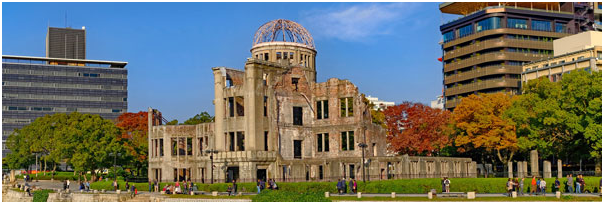
Sadly, the BPI is not able to organize an event this year but we do look forward to the opportunity next year. We are posting this announcement of some international events. If you are able to attend any of them, please do so. Or at the very least add your thoughts to those who are able to gather to stop the madness of nuclear weapons on August 6th and 9th.
Following an appeal to members to send us information on events to mark Hiroshima and Nagasaki Days 2021, here’s a parial list that we have compiled of events received:
Events around the world and online
Peace Memorial Ceremony Live StreamJapan and online 6 August, 6:50 to 8:50 (JST) Watch the ceremony from Hiroshima on this link: https://www.city.hiroshima.lg.jp/site/english/175828.htmlThe 2021 World Conference against A and H BombJapan and online 2-9 August, 2021 “With the Hibakusha, Let Us Achieve a Nuclear Weapon-free, Peaceful and Just World – for the Future of the Humankind and Our Planet” http://www.antiatom.org/english/A minute’s silence during the Olympic Games to remember the victims of nuclear weapons In an effort to have at least a small, but significant, gesture for peace included at these Olympics, Tadatoshi Akiba, former Mayor of Hiroshima has appealed to the IOC to hold a minute of silence on August 6 in commemoration of the anniversary of the nuclear bombing of Hiroshima and in support of a nuclear-weapon-free world.
Your donation helps us to provide you with the networking and information you need in order to eradicate nuclear weapons and power via the 11 points of our Founding Statement. We operate on an absolutely tiny budget and can’t do so without the generous support of donors. Please consider making a donation using the button below.



 Boundary Peace Initiative